by Susan Carroll | Sep 29, 2010 | Random
When I first entered the advertising business, one of the best parts was the “brainstorming” session. Since then I’ve seen the technique either drying up or being used in increasingly disjointed ways during my travels through ad agency lands. Too often, a brainstorm is done under the duress of an impending storm, where the client needs a solution the next day. Or, the brainstorm doesn’t include a key player.
However, brainstorming best practices are starting to make a come back. “North Carolina State University researchers have found that steps taken to make brainstorming sessions more productive can actually lead to success in real-world business environments.” says a recent story in the Washington Post, “The researchers also found one variable that can negate any potential benefits of high quality brainstorming: managerial bias. If a team leader comes into the brainstorming process with well-known preconceived notions, that effectively short-circuits the brainstorming effort — and using best practices will not help.”
by Susan Carroll | Jan 21, 2009 | Random
 Is the Oath of Office written grammatically? Or grammatically written? And who actually messed up? Or who messed up, actually? Was it President Obama or Chief Justice Roberts?
Should “faithfully” come, as an adverb, at the end of the sentence, to modify the whole sentence. Or after “execute”? Or is the oath correctly written with “faithfully” as an adjective placed before “execute”?
Protocol-wise, whose interpretation matters most: Obama, Justice Roberts or God. Apparently Justice Roberts added, “So help you God?” or “So help you God.” at the end.
This last bit– whether declarative or posed as a question — is especially interesting: Is the Chief Justice asking if the President wants God’s help, giving him God’s blessing, or telling him to start praying?
Here’s the actual written oath:
“I do solemnly swear (or affirm) that I will faithfully execute the office of President of the United States, and will to the best of my ability, preserve, protect and defend the Constitution of the United States.”
Where does the oath of office come from? Marvin Pinkert, executive director of the National Archives Experience, displays several original documents regarding the presidential oath of office. Getty Images. From NPR website.
by Susan Carroll | Jan 16, 2009 | Random
Today there’s a lively discussion about Blogging, Social Media and Ethics on MarketingProfs. The question is whether or not it’s right to outsource your corporate blog to a ghostwriter. Some have issues with transparency, others with revealing too much to the competition. However, having a pro outside the organization — an outsider looking in, looking out — writing your blog who is sensitive to the issues and ethical, too makes sense.
I agree with both camps. First off, who wants to read your blog? If it’s dull and corporate, no one — except possibly your competition trying to uncover strategy. Also, why in the world would a CEO want to publicly discuss his business? GM’s CEO has done a stellar job of this. But maybe he should have spent more time watching the bottom line? I found this commentary on corporate blogging from a PR pro insightful.
Using a blog to create a conversation with potential clients is a good idea. If you can show them that you’re thinking about issues that concern them. And want to have them control the conversation.
Copy editing is definitely a good idea (someone of you had “their” instead of “there”) on a corporate blog. If you have one person overseeing the contracted writer/blogger…who’s available on a daily basis…outsourcing to a pro is a great idea: Simply give them a byline as editor to solve the transparency issue.
by Susan Carroll | Oct 6, 2008 | Random
Oh boy, now the National Academy of Sciences is in on this neural marketing thing. Wine tasters thought “more expensive” were “more pleasant’ and even experienced greater pleasant sensations in the neo-cortex, even though, in reality there were no differences in the wine. Hmmm, I guess advertising’s “snoot appeal” can now be proven!
Hmmm, I wonder who funded this study, using MRI brain scans, at the California Institute of Technology? Next thing you know, panels will have their brains wired up during concept testing.
by Susan Carroll | Jun 12, 2008 | Random
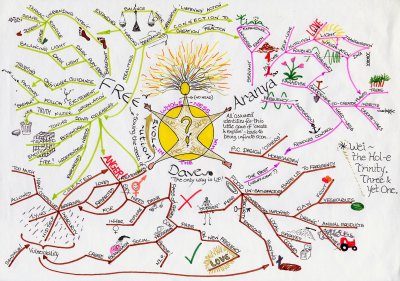
I’ve often wondered when the day will come when your thoughts and ideas can immediately be transcribed and organized. However, until we can perform the Vulcan Mind Meld, here may be the next best thing: Mind-Mapping and Concept-Mapping software. Mind maps let you make a web of ideas and link files to them. Great for brainstorming or doing a story web. Concept mapping is similar, but the construct is more hierarchical: sort of like an outline. This would be ideal for site maps and project management. You can link graphics and files to the branches. There’s even online reviews, such as the Mind-Mapping Software Blog, where today posts a mind-mapping conference in Mooristown, NJ. Or visit The Mind Mapping Blog
Most provide trial downloads or subscriptions. Many offer online collaboration. I am checking out online mind-mapping at the MindMeister site (see illustration to the right). I’m not sure it provides the hierarchical configuration, which is what I really prefer in a brain-storm and for getting too many ideas in the right place. I’ve downloaded a desktop program FreeMind; oddly-enough you’ll find the download link software of this java-based software on Wikipedia, which I’m not sure is quite kosher: but it is open-source.

 online collaboration. I am checking out online mind-mapping at the