by Susan Carroll | Jun 12, 2008 | Random
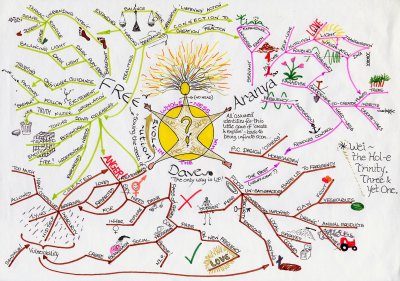
 I’ve often wondered when the day will come when your thoughts and ideas can immediately be transcribed and organized. However, until we can perform the Vulcan Mind Meld, here may be the next best thing: Mind-Mapping and Concept-Mapping software. Mind maps let you make a web of ideas and link files to them. Great for brainstorming or doing a story web. Concept mapping is similar, but the construct is more hierarchical: sort of like an outline. This would be ideal for site maps and project management. You can link graphics and files to the branches. There’s even online reviews, such as the Mind-Mapping Software Blog, where today posts a mind-mapping conference in Mooristown, NJ. Or visit The Mind Mapping Blog
Most provide trial downloads or subscriptions. Many offer online collaboration. I am checking out online mind-mapping at the MindMeister site (see illustration to the right). I’m not sure it provides the hierarchical configuration, which is what I really prefer in a brain-storm and for getting too many ideas in the right place. I’ve downloaded a desktop program FreeMind; oddly-enough you’ll find the download link software of this java-based software on Wikipedia, which I’m not sure is quite kosher: but it is open-source.
by Susan Carroll | Jun 4, 2008 | Random
Revisiting what makes good web copy, I am further convinced that most of the same principles apply from Web 1.0 to Web 2.0.
Usability guru Jakob Nielsen tracked how visitors scan a web page way back in 1996 (see the hot spots in Nielsen’s eyetracking study). He found that readers prefer to scan text written in a concise and objective style. Concise, scannable and objective text scored 128% higher usability.
Another study of video on the web notes that “Talking head videos are boring.” Though the analysis wasn’t yet in, Nielsen surmises that the web is an interactive medium, and that’s why I’m not alone when on zipping through the fast forward. However, a talking head in any promotional context is a killer if you ask me. I grab the remote when that garmento from the Men’s Wearhouse guarantees I’m gonna love the way I look.
But time is shorter than ever. And the need for linking is great. After all, the web is all about linking. So to further paraphrase many a smarter usability expert than me…
Here are my top 8 rules of good website sales copy
Use your titles and subheads to reflect search terms
Tell clearly what it is that you’ve got in your first two sentences. Here a picture is worth a thousand words
Make your next sentence or two about the problem they’re trying to solve by visiting you.
In the next paragraph tell them why you can solve it for them better than anyone else.
In the last paragraph reinforce how you will do it, better than anyone else.
Give them specific links to pages that address their concerns, worries or need to know.
Before they leave, give them an offer they want to refuse…but just can’t.
So what’s different?
To that list, I would add that best practices now dictate keeping your copy “above the fold” or above the cut line. Unlike with the print media, your reader (not you) is in control of the flow and ready to either click to your order, or click away to another interesting site. The trick is to structure your story with the fewest necessary words…not necessarily the shortest copy. Nielsen needs more words to tell his story. Dunkin’ Donuts needs less.
Never overhype or oversell. Nor undervalue what you can offer. Convince your visitor first that what you offer has unique value, and they’ll give you the attention you deserve. If they jump away before ordering or trying, provide them with a promotional pop-up reminder with a deal- sweetener.
Thanks to search engines, and search engine analytics, the copywriter’s job is easier: helping you find the key words and descriptions your audience use to find you. (By the way, I hate that word ‘prospect’, since no one likes to think of themselves that way). But SEO is only the beginning.
Speaking of which: for an insightful and easy read about SEO copywriting, check out CopyBlogger, whose success is the envy of many a writer. It goes to show that the same copywriting rules — which are good writing rules — are the foundation of success, online or off.
by Susan Carroll | Jun 4, 2008 | Random
Traveling back further to good writing. Every writer (and that means you) should read the definitive style manual: Elements of Style originally written by William Strunk in 1918, an easy read full of pithy advice such as:
“Make definite assertions. Avoid tame, colorless, hesitating, non-committal language.”
—Rule 12
It was updated in the ’50’s with the help of another one-time copywriter, E.B. White, author of Charlotte’s Web — a timeless inspiration to all of us do-it-yourselfers on the web.
But how does that translate to this web?
Then as now, give your reader a solution they are searching for. Spin a good story. It could mean saving their life or their livelihoods. Make so easy to understand that solution, that even a child (or caveman or even a pig) can do it. Avoid clunky corporate jargon like “utilize” when “use” will do (by the way I don’t like usability, but it’s a useful word). Then give them more reasons why to use you.
by Susan Carroll | May 8, 2008 | Random
They say that which you resist persists. I’ve been wondering, for about 20 years, why people are seemingly so unable to communicate and cooperate. Why don’t things get done?
What persistent BIG question have you been unable to resolve? I’m talking business-wise, not personal-wise (there’s more of that than can be handled here.)
Cooperation, not competition
That’s why I started IDEA LAND. Creative problem solving is something we all need. So, I started this forum to address these Big Questions with an exchange of Big Ideas.
It’s brand new, so we welcome your participation (no spam or scam allowed.) Here’s your opportunity to promote yourself through cooperation.
The only proviso is that what you provide is authentic, original, thoughtful help…and remember the Boy Scout motto to “Do Your Best”.
by Susan Carroll | May 8, 2008 | Random
A gazillion things competing for attention on the web. Having a great name like Sally Hogshead and smart concept and audacity helps. Sally Hogshead is aiming toward the high life as a consultant and writer of a book/site/attitude called “Radical Careering”. Haven’t read the book, yet, but she’s definitely an inspiring, energetic writer (who’s “easy on the eyes”).
Having a clear POV and engaging in a dialogue with your audience is one of those elephants on the table that many companies miss. Ms, Hogshead hasn’t. Although mine is a more linear virtual world view, I find her site refreshing, ambitious, if not perfectly navigable. (Like I should talk me with my old posts and broken links 🙂
I comment about what it really takes to be a great online writer on her Hog Blog, It’s Time to Upgrade to You 2.0.
by Susan Carroll | Feb 10, 2007 | Random
Blogging is a great way to connect with people you’d never imagine you could.
If you’re an entrepreneur or marketer, you’ll be inspired by Guy Kawasaki’s Art of the Start . He really distills everything down into an entertaining 20 minute talk!
The original Mac Evangelist is now Managing Director of Garage Technology Ventures…I found his blog exceptionally refreshing. He embodies all that we love about Apple: Simple, elegant, and about “Changing the World.”
I wish the Corporate Entity that Apple has become lived up to its earlier promise. A couple years ago I tried to discontinue the iLife subscription, which I couldn’t do except through the .mac website…which wouldn’t let me. My long-held affection for Mac completely ended when a tech support assured me it was ok to reboot the computer from the disk, “to fix the permissions” while FileVault was on. NEVER DO THIS!
All my files got locked away in a sparse.image file and my master password no longer worked. Apple reminded me that there’s a warning, but they did give me and a free copy of Tiger.
However, when I compare this experience to my fiance’s frustration with Vista and automatic Nazi-like updates from HP, I remain an Apple Evangalista.
by Susan Carroll | Feb 5, 2007 | Random
If advertising is a mirror that reflects society, as Stephen Fox says in “The Mirror Makers”, what do the latest Super Bowl ads say about us? Looking in this giant convex mirror, objects appear closer than they really are: the babes, the celebs, even the animals, are self-deprecating in a way that makes them seem “more like us”. If you consider it’s mostly bright 20-something men (and I use that term loosely) writing the ads (and the demographic all marketers desire), you can understand why advertising as an art form has become more self-referential, ironic, fantastic and deconstructed. As advertising, what are we selling here? Super Bowl ads are less about the product benefits and more about our messy psyches and desires. Like Bud-light, they exist to generate buzz 🙂
Alexander de Toqueville, if he were to visit America today and become instantly acculturated, might observe:
Every American can (literally) have his 15 minutes of fame or at least an easy Creative Directorship.
Doritos “Crash the Super Bowl” commercial (See earlier “Doritos” post) My favorite, “Checkout Girl” was the winner: the chubby cashier checks out and wins over the junk-food hunkie through her provocative recitation of Doritos spicy flavors. This is good advertising.
Chevy’snaked men tearing off their clothes in the street to go wax the chevy was the winner of a college competition (note to self: definitely not sending my kids away to college). Clients just love seeing the masses flocking to their product. No wonder GM is in trouble.
We live in desperate times. It seems we have come to accept humiliation as a norm. To wit:
Budweiser’s “Slapping”. Funny, yes, in a slapstick way. But “Dogs” was better: A downtrodden mutt, splattered with mud, finally rides in a parade with the Clydesdales (“Under Dog”, or “Dog Day Afternoon”, or “Every dog has its day” would have been better titles).
Into this cute animal category you could add GM’s “Robot Arm”, where a robotic arm gets fired for lack of performance (guess he didn’t pay his union dues). I bet you GM’s employees really relate to Career Builder’s campaign. No more monkeying around, the “Jungle” spot shows “best practices” gone awry when corporate team members break into a free-for-all armed with office equipment.
Every ghetto has its silver lining.
Coke’s “Vice”, turns a “Grand Theft Auto” character into a Good-Deed Doer. Nice attempt, except for the crashing cars, to turn a negative into a positive.
Finally, as much as I admire the Nationwide campaign for making annuities relevant, I’m sad to say that it reinforces the notion that no financial institution, including Nationwide, is “on your side”…
View my list of Super Bowl Ads
PS: My personal favorite is for Jack-in-the-Box that didn’t air in my market. I love the twist at the end where JB jr. mixes up “Vegetarian” with “Veterinarian”.
by Susan Carroll | Jan 31, 2007 | Random
Last night my town made the NBC-10 local news with a story about showing third-graders “That’s a Family!” “A film for kids about family diversity”. It apparantly features families headed by those of mixed race and unmixed gender. About 300 families, mostly irate, showed up at a school meeting.
it is a great way to get more people involved in the PTA, if you ask me 🙂 But one wonders why talking about alternatives to the Mommy-and-Daddy-headed-household is so controversial. Over half the nuclear families are now divided. And the “alternative lifestyle” is a staple of prime-time TV, with freaks and fantasy increasing ratings. My guess is that these families’ V chips work better than mine, because my kids seem to know more about what goes on in the privacy of alternative lifestyles than I do.
What probably irks my neighbors, as it does me, is that there is very little support for family ideals of any sort. In the real world, family is “99% perspirations and 1% inspiration” — it’s difficult, tedious and subject to uncontrollable forces of erosion. So, when we go to our local video store to rent a movie to escape from all this — could we possibly have more choices for families, of whatever stripe?
Indeed, why can’t we get versions of hit movies, such as “The Aviator”, with the smuttier scenes deleted? And, hey Hollywood, could we have a little more about Howard Hughes as the ingenious aviator and entrepreneur that he was…and less about the playboy and freak he became?

 online collaboration. I am checking out online mind-mapping at the MindMeister site (see illustration to the right). I’m not sure it provides the hierarchical configuration, which is what I really prefer in a brain-storm and for getting too many ideas in the right place. I’ve downloaded a desktop program FreeMind; oddly-enough you’ll find the download link software of this java-based software on Wikipedia, which I’m not sure is quite kosher: but it is open-source.

